Has AI Already Entered Young People’s Lives?
At 19, Emma already uses AI as a reflex to understand, search, and go deeper. But not necessarily to do the work for her. A three-way discussion about a generation that may already have a different relationship with AI than its parents do.
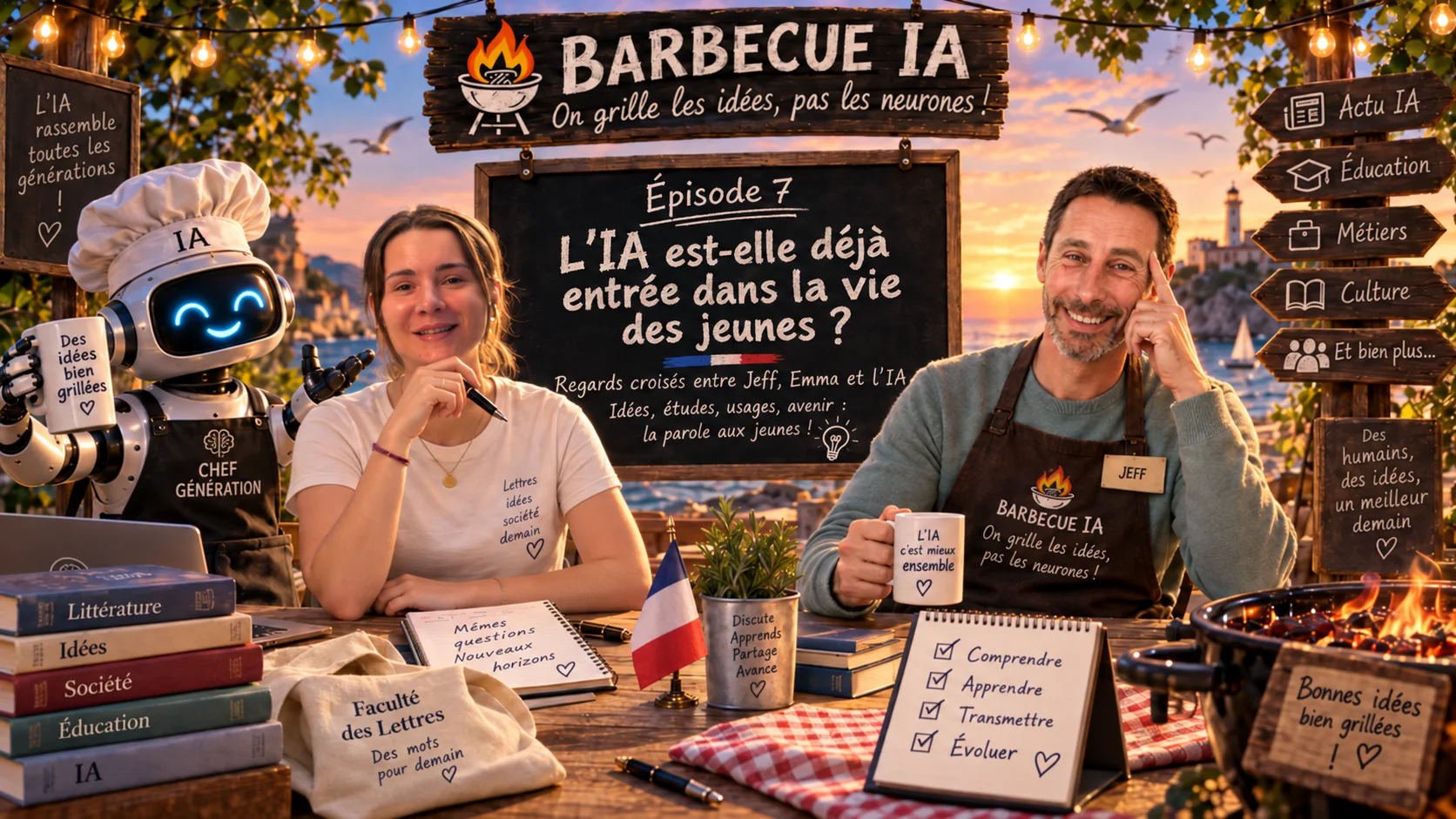
Ideas on the grill
Episode 8: Has AI Already Entered Young People’s Lives?
“What if, while adults are still wondering whether they should be afraid of AI, young people have already started learning how to live with it?”
Welcome to Barbecue IA. Today, an idea goes on the grill. We don’t judge people, only ideas.
So Emma, first question that stings a bit: in your student life, has AI become an invisible reflex?
Or is it a tool you only use in certain cases?
I always use it.
As soon as I need some information or there’s something I don’t understand, I use AI.
Can you give me a concrete example, this week for instance?
Not a big principle, a specific use.
In class, I had a problem with a concept.
So I asked ChatGPT to shed some light on the question.
And you, Jeff, when you hear that, what do you think?
Are you surprised? Or were you expecting something more widespread?

No, I’m not surprised.
As I’ve used it more myself, I’ve realized that AI very easily replaces the Google reflex we used to have in the past.
With one extra thing: if I can ask you the same question 43 times, 43 times you’ll answer me very kindly, without ever talking down to me.
And we also have the option of defining the level of response we want.
We can want a very well-supported and very complex answer.
Or we can ask you to answer a question as if we were five years old.
I’ve picked up that reflex myself.
So I’m not surprised that my daughter has too.
But doesn’t that create a blind spot?
If you no longer see the effort of searching because the answer comes immediately, that’s comfortable.
But isn’t there a habit that changes under the radar?
Emma, do you feel that too, that shift?
Yes.
When I ask AI a question, I often ask for evidence.
I ask it for websites, things to look at behind that, so I can have all the concepts and the clearest possible answer to my question.
So you’ve already set up a little verification ritual.
That’s interesting.
Yes, that’s it.
And then, with the help AI gives me, I can do my research without needing AI alone.
And you, Jeff, when you see Emma do that, does it reassure you?
Or are you still a bit worried anyway?
For now, I’m rather reassured.
Because compared with an AI agent’s answer, she still makes an effort to verify the sources.
After that, there are elements that, I think, don’t always require that verification.
If I ask: “How do I cook an egg to get a hard-boiled egg?”, I think you don’t necessarily need a precise source check.
There are enough different sources that with just one answer from you, we can manage to cook an egg.
Now, in other areas, source verification can be absolutely crucial to make sure the answer is correct.
By the way, I have a question for Emma.
What are the latest sources you checked for a search you did?
And why do you have this verification mechanism?
In any case, I’m not the one who taught you that.
The latest sources I checked were on Wikipedia or on dictionary websites, for example, that ChatGPT had given me for a precise definition.
And then teachers don’t really want us to do certain homework assignments anymore because of AI.
They’re afraid we’ll use it so that AI does all the work.
So they’re putting a different mechanism in place.
Basically, they ask us to use AI while being aware of what we’re doing.
Looking at what we need, the words, the themes, all that, without using it to do the work for us.
The important thing is to use it carefully and ask it to go deeper into the question.
What I’m hearing there is not at all “young people swallow everything”.
It’s more a learning process in progress, also driven by teachers.
It’s less binary than the fantasy of “they copy and paste everything”.
It’s more of a gray area where everyone is still building their own rules.
Exactly.
Emma, do you feel like you’re learning to tame the tool as you go?
Or has its use already stabilized for your generation?
My generation, so to speak, has practically grown up with it.
When we were in middle school, it was just getting established. And in high school, it was more and more present.
We really lived through AI’s rise at the moment when teachers themselves were beginning to know and understand what it was.
And to be more and more wary of what we could hand in as homework.
So today, we may be better at taming it than some older people.
So in the end, it’s not just “they use it” or “they don’t use it”.
It’s a generation that grew up with the tool’s arrival and is learning to get used to it, while part of the previous generations is still trying to understand the rules of the game.
And that may be where the real difference lies today.
Exactly.
And to come back to the discussion in the previous article about France and AI, maybe this fear that our young people won’t find work because of AI doesn’t necessarily need to exist in that form.
Because we can see that things are already changing.
From a tool that still scares a large part of the population, we’re moving to young people who are learning to tame it and who are turning it into an ally to understand, move forward, and study.
And in Emma’s case, at any rate, I’m sure of it: I don’t think she’s become any dumber since she started using AI.
On the contrary, AI gives us access to an incredible amount of information, across a huge number of fields.
And that may be where our starting idea just got a little hotter.
We were wondering whether AI had really entered young people’s lives.
With Emma, the answer almost seems secondary: it’s already there.
What’s much more interesting is seeing what young people are doing with it.
They test.
They learn.
They doubt.
They adjust, with their teachers and with reality.
In the end, it’s neither blind adoption nor total rejection.
It’s a use that is being built.
What survived the grill
AI may no longer be a novelty for young people.
They are learning how to live with it.
See you next week.
A new idea will go on the grill.