Barbecue IA: Is PC SOFT Taking Developers' Clients Away?
After years of earning his living with WinDev, Jeff explains why he is distancing himself from PC SOFT. Dongles, SaaS, runtime fees and end clients: a candid account of broken trust.
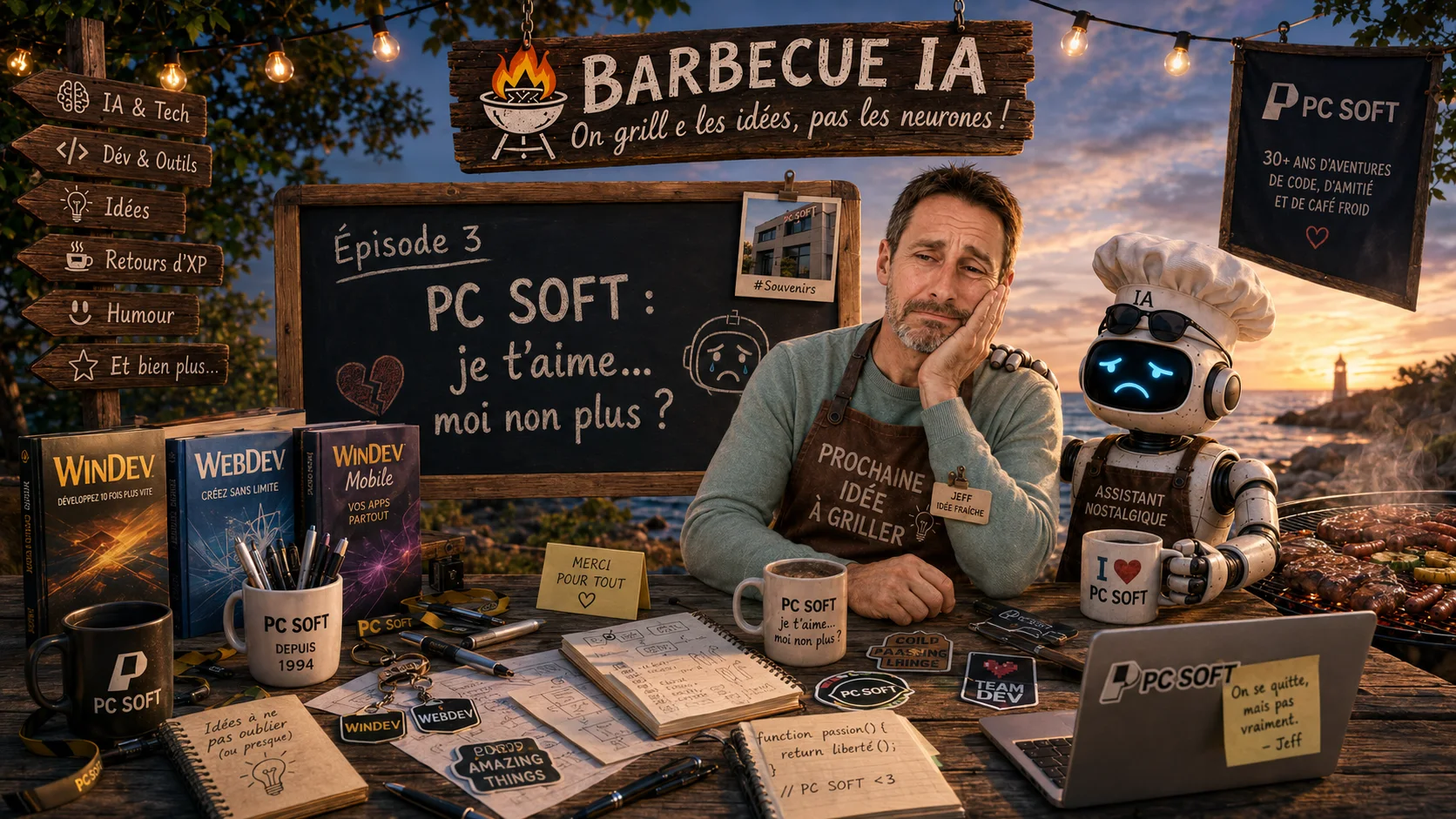
Ideas on the Grill
Episode 3: Is PC SOFT Taking Developers' Own Clients Away?
"We do not judge people here. We put ideas on the grill. And sometimes... they come out stronger."
Jeff, you have worked with PC SOFT tools for years.
Do you still stand by that choice today?
Or do you sometimes feel that you built part of your career on a proprietary sandcastle?

I discovered PC SOFT environments during my technical degree.
At the time, I found them frankly laughable.
They had been presented to me as tools that created everything, almost automatically. I saw no value in that because I came from Visual Basic, where practically everything had to be built by hand.
Then someone very close to me showed me WinDev in a professional context.
And that is when I fell in love with the language.
I immediately connected with the way it worked. The fact that it was proprietary did not bother me at the time.
From the outside, that love still looks like a comfortable form of lock-in.
Do you regret investing so much in a proprietary ecosystem?
No.
I stand by that choice without reservation.
For years, I earned my living through the tools provided by PC SOFT. I am not going to regret that choice or bite the hand that fed me.
Without PC SOFT, I probably would not be where I am today.
You stand by the economic outcome.
But technically, did those tools never limit you?
Never frustrate you?
Overall, WinDev lets you do a great many things.
I worked less with WinDev Mobile, although I did have some experience with it.
WebDev, on the other hand, frustrated me considerably.
When you look at what can be done with open-source technologies, it raises serious questions.
For example, I wasted a huge amount of time on something as basic as a total row in a table that would remain permanently visible, as it can in WinDev.
A simple sum.
And yet I lost time over it.
I still lose time with WebDev today.
We are sometimes told that these tools let us develop ten times faster. With WebDev, I often felt that I was developing ten times more slowly.
Then why did you stay?
Loyalty?
Inertia?
Or because leaving the ecosystem would have cost too much?
Loyalty was part of it.
But it is important to remember that close to 90% of my revenue came from development work carried out with PC SOFT tools.
Until recently, I also maintained very good relations with the company's management.
When PC SOFT moved to a SaaS model, I supported that decision.
At the time, the idea seemed coherent: recurring revenue could support more continuous development of the tools, without waiting for a new annual release to receive fixes or improvements.
On paper, it could have given us a stronger development environment.
In hindsight, I believe my support was misguided in light of the commercial strategy that subsequently emerged.
Does your problem come from having placed your trust in that ecosystem, its promises and its management?
And when the strategy changed, did you find yourself exposed, with no real way out?
No.
I am not afraid to change languages. My experience allows me to work with other technologies.
That is not the problem.
Instead, I feel as though I am being dispossessed of all the source code I have written over the years.
Without the tools and the compiler, that code already cannot be used normally.
From my perspective, the end of hardware dongles felt like a stab in the back for developers.
Previously, owning the dongle meant that you could continue using a version you had purchased. Under the model I am criticising, stopping payment now means losing the ability to work with the tool.
Then comes billing linked to runtime usage.
And that creates a genuine intellectual problem for me.
I develop a piece of software.
My client pays for my work.
But the client would then have to keep paying to use that program.
At that point, I feel that my own clients are becoming PC SOFT's direct customers.
At that point, we are no longer talking only about a development tool.
In your view, is PC SOFT moving from being a vendor that serves developers to becoming an unavoidable intermediary between developers and their own clients?
And does that development cross a red line?
Yes.
It absolutely crosses a red line.
That is why, unfortunately and reluctantly, I am distancing myself from PC SOFT today.
I have expressed this directly to its management, in my own name.
And I am genuinely saddened by it.
What has been deeply damaged is the capital of trust.
Today, it has been completely eroded.
I am also concerned about the financial burden this model may place on end clients and independent developers.
Some professionals I have spoken with say they have been left high and dry and fear that they may no longer be able to continue their business normally.
For my part, one thing is certain: I will never commit to a proprietary language again.
For years, you used these tools to develop applications at the heart of your clients' businesses.
Do you now feel any responsibility towards the companies that still depend on this ecosystem?
I do not accept responsibility for this change.
I did not sell PC SOFT to my clients.
I used a tool that suited me to meet their needs, under contracts that were clear when those decisions were made.
When I started working with these tools, and even as recently as 2023, I had no reason to imagine that dongles would disappear or that the strategy would move in this direction.
I could not have anticipated such a change.
The problem is that the rules changed after developers and companies had invested deeply in the ecosystem.
You go even further.
You believe that the move to SaaS first locked developers in before runtime billing was introduced.
That is a serious allegation.
What specifically led you to that belief?
I need to be precise: I cannot claim that this plan existed from the outset.
It is an interpretation I have formed in hindsight.
I have seen several LinkedIn posts describing comparable developments at other companies acquired by the Volaris Group.
The example of 4D has been mentioned, with what was presented as a similar billing model, although I do not believe that product used dongles.
Those elements reinforce my personal conviction.
But it remains my interpretation, not proof of a plan that I could demonstrate.
Now imagine that PC SOFT's management is sitting at this table.
You have one minute.
Not to settle scores.
To explain what could still restore your trust.
What do you say?
We had a French software vendor that enabled an entire ecosystem to operate.
A vendor embedded in countless industries and companies.
I would say this:
"It is time to wake up."
"It is time to reverse course."
"And it is time to restore order and integrity to your commercial strategy."
I think I understand what actually broke.
You did not stop believing in the value of the language that helped you build part of your career.
You are not ashamed of having used it.
You do not reject the projects delivered, the money earned or the years invested.
What you reject is the idea that a tool purchased to serve your profession could gradually become a toll gate between you, your work and your clients.
The disillusionment does not come from a technical limitation.
It comes from a breakdown of trust.
And when a vendor controls access to the code, the ability to compile it and the client's right to use the software, developers no longer ask only whether they own their tool.
They begin to ask whether they still truly own their business.
What Survived the Grill
A software vendor ceases to be a partner when it becomes the mandatory toll gate between developers, their code and their own clients.
See you next week.
A new idea will go on the grill.