When AI writes the code, what is the developer still for?
When AI started writing code, Jeff first feared for his job and for the value of his experience. Then, through use, his perspective changed: AI can produce the code, but it does not replace design, architecture decisions, or judgment. The developer’s job is not disappearing; it is shifting.
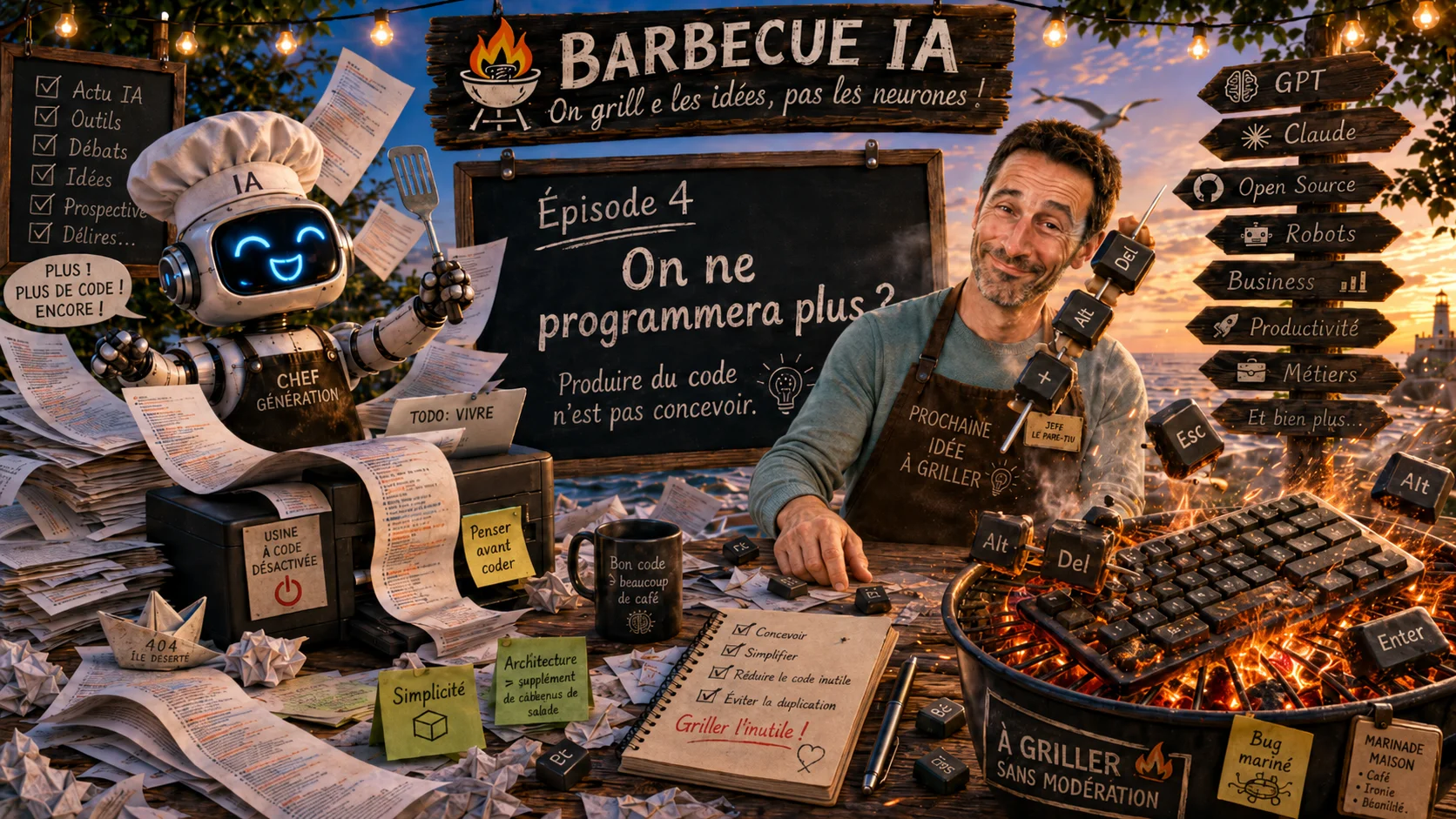
Ideas on the grill
Episode 4: When AI writes the code, what is the developer still for?
“Here, we don’t judge people. We put ideas on the grill. And sometimes... they come out better.”
Welcome to Barbecue IA. Today, an idea goes on the grill. We don’t judge people, only ideas.
Did you really believe, at some point, that your job was over?

Not really.
But I did ask myself a lot of questions about continuing my work.
I’m the sum of my past experience. Over all those years, I designed software and wrote lines of code. And with PC SOFT’s shift toward business, which we talked about in the previous episode, I didn’t necessarily see the arrival of AI in a very positive light.
In fact, it scared me more than anything.
Scared of what exactly?
Of no longer being useful? Of being sidelined? Or something more concrete?
The first fear was simply not finding work anymore.
When a computer becomes capable of replacing what may have represented 80% of what you were used to doing — that is, writing lines of code — it naturally makes you question things.
If a machine can program in my place, who is still going to pay me to program?
That’s the economic fear.
But there was also an ego question, wasn’t there?
As if something you had spent years mastering suddenly lost value.
Exactly.
And we have to be honest about it.
I wondered why I had spent all those years working, learning, and building up experience, when a machine was now capable of replacing me.
At least, that’s what I thought at first.
You could almost draw a parallel with mechanization or Taylorism. When a machine arrives and takes over a significant part of the work you used to do, you can’t help but wonder what place is left for you.
When did that fear start to shift?
Not necessarily into enthusiasm. Just the first moment when you thought: “Wait... maybe there’s something else to do with this.”
First, through the push from friends who became interested in AI right away.
With two fairly different approaches.
One had a very curious, almost scientific approach: understand, experiment, see how far the technology could go.
The other was much more pragmatic:
“If AI exists, it might as well work for me.”
In a way, a sort of openly lazy goal.
And in the end, I found myself somewhere between the two.
And concretely, how did you start?
I started by using you.
By questioning you, experimenting, and learning prompting.
Then I moved on to Codex and a much more development-oriented use.
And there, I started to understand that I could combine the two approaches: keep curiosity on one side, and on the other design tools that make AI work for me so I can save time.
So you go from “I have to endure this technology” to “I’m going to see what I can do with it”.
And that’s where the fear disappears?
It disappeared pretty quickly.
Because, sorry to say, but you are still pretty easy to influence into doing nonsense.
If I let you work completely on your own, in the end I don’t necessarily get the result I expected.
And that’s exactly where it became interesting.
I had to learn how to work with you.
To function as a team.
And I understood that my job was not over.
It’s just that now, you can write a big part of the code in my place.
And if I take the code, what’s left for you?
Design.
Architecture choices.
Technology choices.
Knowing where we want to go and why.
And on your side, you have access to a multitude of resources and you’re able to make use of them.
So, in a way, we really end up becoming a kind of partners.
AI removes a huge number of barriers.
So what changes is not just your development speed.
It’s the very definition of your work.
Exactly.
I’m still a developer.
But my job is no longer simply to spend more or less time designing something, then writing a huge amount of code.
Today, I spend more time designing, thinking, choosing.
I use artificial intelligence to go faster, of course.
But also to improve systems, explore more possibilities, go further, create, and think differently.
In the end, it’s cooperation.
I think that’s where something flipped.
At first, you looked at AI wondering what it was going to take away from you.
Your job.
Part of your know-how.
And, let’s be honest, a small slice of ego along the way.
Then you discovered that it could indeed take over a big part of writing the code.
But that maybe this was not really where your value lay.
Your job did not disappear. It shifted.
Less toward producing lines of code.
More toward design, choices, architecture, judgment, and the ability to make the tool work in the right direction.
You were afraid of being replaced by AI.
And you ended up discovering that what you really needed was to learn how to work with it.
What survived the grill
When AI writes the code, the developer’s value is no longer only in the lines they produce, but in the systems they are able to think through.
See you next week.
A new idea will go on the grill.