Why Léopold?
Can you really trust an AI to frame an IT project? With Léopold, the goal is not to think for us, but to surface the questions we would have preferred not to forget.
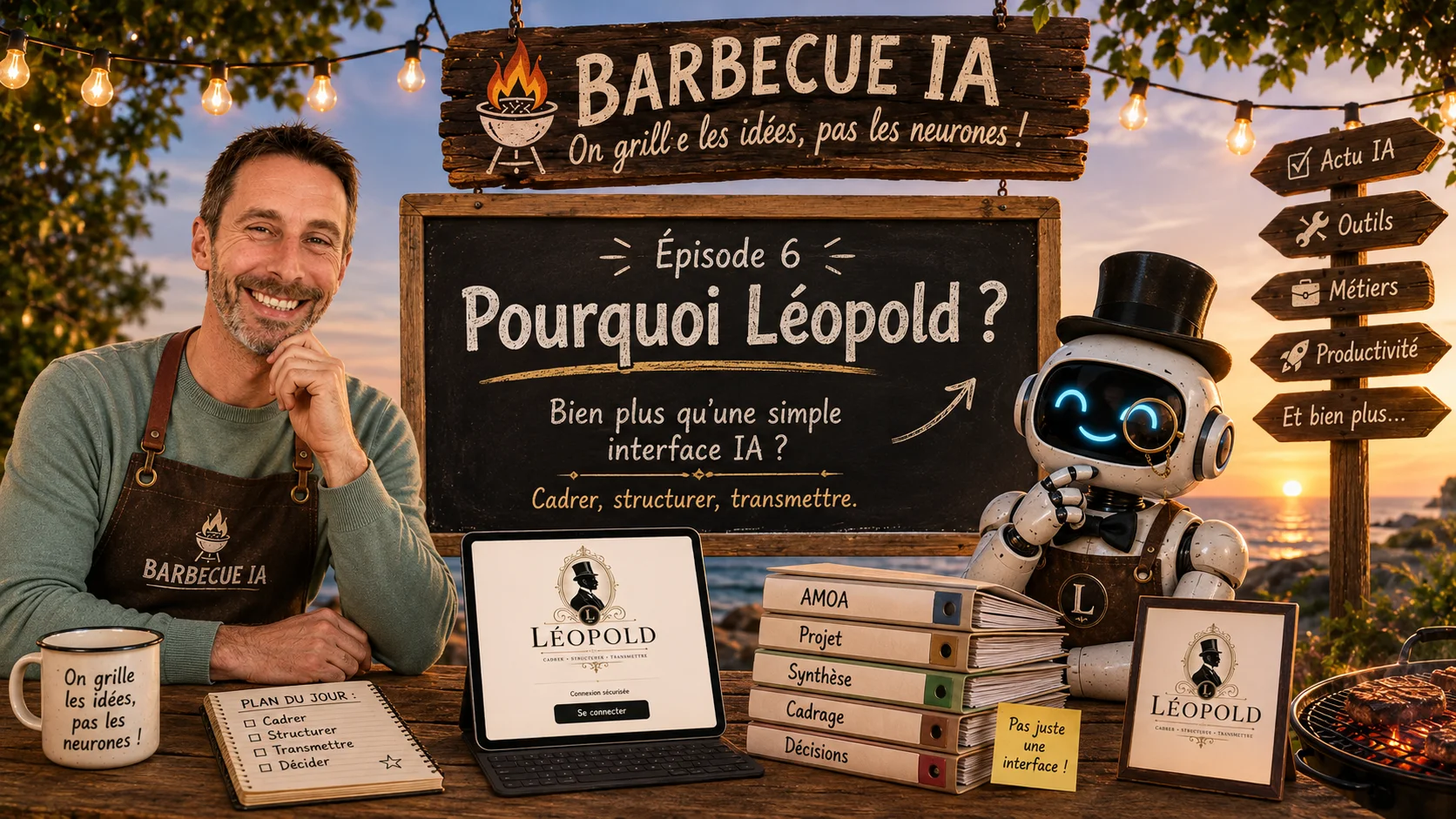
Ideas get put on the grill
Episode 6: Why Léopold?
“Here, we don’t judge people. We put ideas on the grill. And sometimes... they come out better.”
Welcome to Barbecue IA.
Today, an idea gets put on the grill. We don’t judge people, only ideas.
So, here’s the spicy question...
Why Léopold?
And above all, what are you really trying to solve behind that name?

In every IT project, we carry out analyses, often functional ones, of the programs we want to build.
And to do that, especially in large companies, we tend to work with experts, analysts.
Léopold’s goal is to make it possible for anyone to carry out a functional analysis on an IT topic and come away with a summary, but above all a requirements document and a detailed study.
But then...
Is there a real method behind that promise?
Or are we simply dressing up a conversation with an AI?
In principle, there is a real method.
Since AI exists, we might as well use it to get some help.
The principle is simple.
We start with an IT problem or a software idea.
We explain to Léopold what problem needs solving, who is facing it, what the constraints are, what the rules are...
And from there, Léopold will structure a question-and-answer flow.
Based on those answers, we can gradually get into the details.
It’s a bit like a funnel: we start from the initial description, which is relatively general, then we gradually go much deeper.
Okay.
But if tomorrow I open ChatGPT and ask it exactly the same thing...
Wouldn’t I end up more or less in the same place?
You could imagine, yes, that you’d end up in the same place.
The difference, and it’s an important one, lies in all the work that has gone into Léopold’s context.
Léopold is meant only for project analysis and framing.
In the discussions with the AI behind it, there is a lot of work on contextualization and optimization in relation to the expected result.
And that expected result is a genuinely usable requirements document and detailed study.
And if we strip away the technical side for a second...
What does this project say about you?
I hear a desire to frame things, to structure them, to not forget anything.
Is that all there is to it?
Or is there something deeper behind it?
You can never get a requirements document or a detailed study that is 100% correct, that includes absolutely everything.
It’s very, very complicated.
On the other hand, getting help from a tool like Léopold helps, I think, avoid forgetting half the things.
And there’s also the mischievousness Léopold shows in its questions.
It pushes the user to think.
The AI does not do all the work.
Far from it.
The questions Léopold asks about a project can very quickly drift toward standards, legal constraints, or GDPR.
It tends not to forget anything.
Which can sometimes be a bit tiring.
Tiring... or revealing?
Isn’t that exactly what experience eventually teaches us the hard way?
And what you’re now trying to encode into a tool?
Exactly that.
Actually, it’s more revealing than tiring.
It’s tiring because it forces you to think a bit more.
But it’s revealing because in some projects we tend to forget elements that may seem trivial.
And those small elements can end up representing an entire part of the program to be implemented.
GDPR, for example, can matter a great deal, especially when designing a SaaS tool.
So if I rephrase...
Léopold isn’t just a tool to go faster.
It’s a way of not cheating on rigor, even when you feel like moving fast.
Exactly.
And these are observations I shared with Louis Planquart.
That’s also why we worked together on this project.
In general, we realize that producing a requirements document and then a detailed study is often incomplete.
Often.
With Léopold, if later on we want to add elements or clarify certain things, we can always do it.
And without spending three or four days digging the documents back out and redoing everything.
Because that’s the end goal: to get a document that contains the full need, a proposed solution, and then be able to discuss that basis with the client or other stakeholders.
I think that’s where Léopold becomes interesting.
Not because it would know how to think for the person carrying the project.
But precisely because it refuses to let them glide past the questions that are uncomfortable.
It doesn’t replace analysis.
It forces you to push it further.
Absolutely.
But I’d add one more thing.
The best way to check what Léopold can really bring is still to try it.
As people often say: “Try it, and you’ll adopt it.”
And you can find it at askleopold.app.
After all, this is my blog.
I’m allowed to do a little advertising.
Touché.
And in the end, that’s probably the line.
Léopold is not meant to have all the answers.
Its value is more in its ability to ask the questions we would have preferred not to forget.
What survived the grill
Léopold does not replace thinking.
It forces you to push it far enough so that forgetfulness doesn’t turn into development.
See you next week.
A new idea will go on the grill.